
How to Become a Property Manager in California
Learn the exact DRE licensing steps, experience rules, and hiring tips to become a property manager in California. Start your path today.
If you want to know how to become a property manager in California, here's the short answer: the state does not hand out a property manager license at all, you need a real estate Salesperson or Broker license from the Department of Real Estate instead. That trips up a lot of job seekers coming from states where property management is its own license, or no license at all. In California, leasing units, collecting rent, and negotiating with tenants on behalf of an owner all count as licensed real estate activity under the DRE.
This means the road to a leasing office or a property manager title runs through the same licensing process as becoming a real estate agent. You'll need to complete DRE-approved coursework, pass a state exam, get fingerprinted, and work under a sponsoring broker before you can legally manage property for someone else. From there, building real hours as a salesperson is also what eventually qualifies you to become a broker and run your own management company. The rest comes down to the specific hours, costs, and experience requirements the DRE sets, plus what it actually takes to land the job once you're licensed.
Table of Contents
Why California Treats Property Management As Real Estate
The DRE draws a clear line around what counts as licensed activity. Negotiating a lease, setting or collecting rent on an owner's behalf, and soliciting prospective tenants all require a salesperson or broker license. If you're handling any part of the deal between an owner and a tenant, you need to be licensed.
Two groups are exempt. On-site resident managers who live at the property they manage, and clerical staff who work strictly under a broker's supervision, don't need a license for those specific duties. That's why you'll see "on-site manager" job titles that don't require a DRE license, while "property manager" or "leasing agent" titles usually do.
| Activity | License Required |
|---|---|
| Negotiating leases or rent terms | Yes |
| Collecting rent for an owner | Yes |
| Soliciting or showing units to prospective tenants | Yes |
| Living on-site as a resident manager | No |
| Clerical work under a broker's direct supervision | No |
If your job involves any of the first three activities on behalf of someone else's property, plan on getting licensed before you take the role.
Complete Your 135 Hours Of DRE Coursework
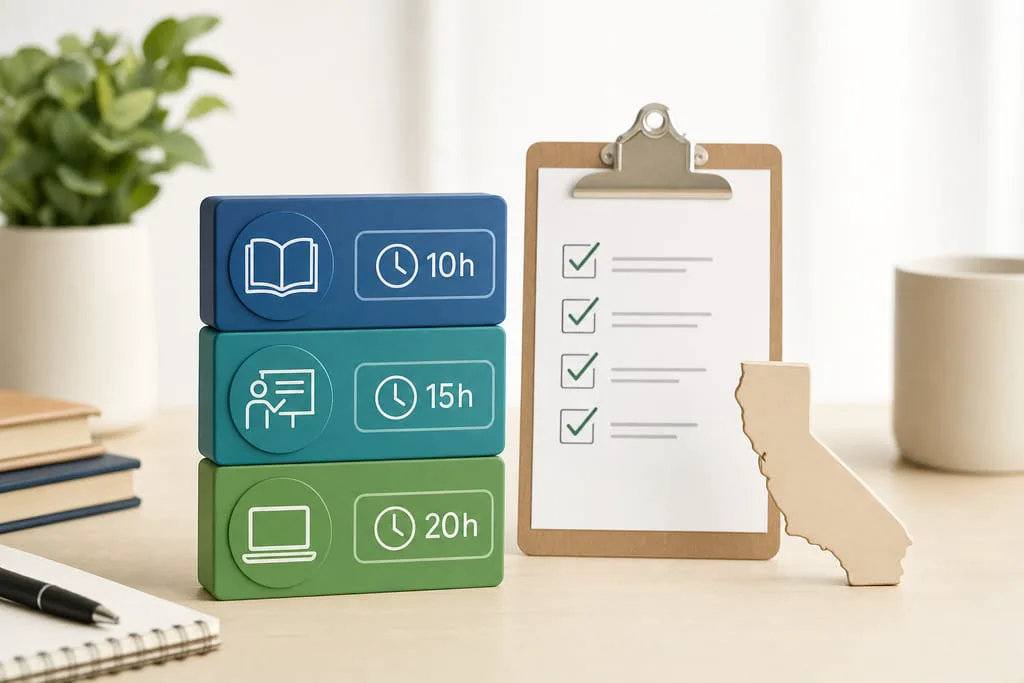
Before you can even sit for the exam, the DRE requires 135 hours of coursework split across three classes: Real Estate Principles, Real Estate Practice, and one elective. Each course runs 45 hours, and property management is one of the elective options, so you can tailor your third class toward the job you actually want.
All three courses must come from a DRE-approved school, not just any community college or online provider. Check a school's approval status before you pay for anything, since credits from an unapproved program will not count toward your exam eligibility.
Since January 1, 2024, the Real Estate Practice course has to include an implicit bias and fair housing role-play component, so newer coursework looks different than what an agent licensed five years ago went through. Beyond the hours, the DRE also requires you to be at least 18 years old and to demonstrate honesty on your application, and a criminal conviction can lead to denial even after you finish the coursework.
- Real Estate Principles: 45 hours
- Real Estate Practice: 45 hours, includes fair housing role-play since 2024
- Elective (Property Management or similar): 45 hours
Pass The Exam And Clear Your Background Check
The California salesperson exam has 150 multiple-choice questions and a 3 hour 15 minute time limit, and you need 70% correct, or 105 questions, to pass. Revei lists the exam fee at $100 per attempt, though DoorLoop cites a combined exam and license fee of $450, so confirm the current number directly with the DRE before you schedule a test date.
You can sit for the exam at DRE testing centers in Sacramento, Oakland, Los Angeles, San Diego, or Fresno. Pick whichever location cuts down your travel time, since you may need a retake if you miss the passing score on your first try.
Alongside the exam, you'll need Live Scan fingerprinting for your background check, which runs roughly $49 to $70 depending on the provider, plus a $56 DRE processing fee. This step only happens once, even if you later move up to a broker license.
- Study for and schedule the 150-question exam
- Pass with at least 105 correct answers
- Complete Live Scan fingerprinting at an approved location
- Submit your application through DRE eLicensing
Know The Experience Rules For Salesperson And Broker
A new salesperson needs zero prior work history to get licensed, but you cannot practice until a sponsoring broker activates your license. That broker oversees your early work, including any property management duties you take on.
Moving up to a broker license is a different bar. You need two years of full-time licensed salesperson experience within the last five years, or two years of equivalent unlicensed real estate experience, or a four-year degree with a real estate major or minor plus eight college-level courses.
Under AB 2745, effective January 1, 2023, applicants relying on unlicensed experience must show that work happened within the five years before they apply, not spread out over a longer career. Time spent working as a property manager is specifically cited as likely to count toward that equivalent experience requirement.
- Salesperson path: no experience required, license activated under a sponsoring broker
- Broker path: two years full-time licensed experience in the last five years
- Broker path alternative: two years equivalent unlicensed experience, also within five years
- Broker path alternative: four-year real estate degree plus eight college-level courses
Land Your First Job With A Sponsoring Broker
Finding a sponsoring broker is the step that turns your license from paper into a paycheck, since the DRE won't let you practice until your license is activated under one through eLicensing. Reach out directly to property management companies, apartment communities, and brokerages that are known to sponsor new licensees, rather than waiting for them to come to you.
If you worked leasing, maintenance, or customer service before getting licensed, put that experience front and center on your resume even if none of it was done under a license. Hiring managers care that you've already handled tenants, vendors, or front-office work, licensed or not.
Entry titles like Assistant Property Manager or Leasing Consultant are the realistic starting point for most new salespeople, with full Property Manager responsibilities coming once you've built a track record. Before accepting any offer, ask about commission structure, the unit count you'd be responsible for, and on-call expectations, since those details shape the job more than the base pay alone; sites that focus specifically on property management listings tend to spell these details out more clearly than general job boards do.
- Contact brokerages and property management companies known for sponsoring new licensees
- List leasing, maintenance, or customer service experience on your resume
- Apply to Assistant Property Manager or Leasing Consultant roles first
- Ask about commission, unit count, and on-call duties before you accept
Staying Licensed Versus Stacking Credentials
Your salesperson license lasts four years, then you owe the DRE 45 hours of continuing education covering Ethics, Agency, Trust Fund Handling, Fair Housing, and Risk Management. AB 2992 added mandatory implicit bias content to that renewal, so the coursework looks different than it did a few years back. This is the baseline cost of staying licensed at all, and it applies whether you're managing five units or five hundred.
A separate choice is whether to add credentials beyond the minimum, like the CCRM from the California Apartment Association, or national ones like CAM, CPM, NALP, and MPM. These cost money and time on top of renewal, and they don't replace your DRE license, but they signal to a hiring manager that you've gone past the legal floor. If you're applying against other licensed candidates for the same Property Manager opening, a CPM or CCRM on your resume is the kind of thing that separates you from someone who just kept their license active.
Either way, you need to know the law changes that affect your daily work, since renewal education won't cover every new statute the moment it takes effect. AB 12 caps most security deposits at one month's rent as of July 1, 2024. AB 2801 requires photographic evidence of unit condition before and after move-out starting April 1, 2025. AB 1482 sets the statewide rent cap and just-cause eviction rules that shape nearly every lease renewal and termination decision you'll make on the job.
| Requirement | Who it applies to | What it costs you |
|---|---|---|
| 45-hour renewal education | Every licensed salesperson or broker | Time, every four years |
| AB 2992 implicit bias content | Everyone renewing | Added hours within renewal |
| CCRM, CAM, CPM, NALP, MPM | Candidates competing for better roles | Money and study time, optional |
Start Reaching Out Before Your License Even Clears
Don't wait for a passing exam score to start emailing brokerages. Call or message property management companies and apartment communities now, while you're still finishing your 45-hour elective, and tell them you're on track for licensure. Many sponsoring brokers would rather train someone who's already applied than wait for a finished license to land in their inbox. Picking a sponsor isn't just about who answers first either, since the broker you choose shapes what kind of properties you'll work on and what your path to a broker license looks like later. A site built around property management and maintenance roles, like Property Management Jobs, makes it easier to spot which companies are actively hiring licensees right now instead of guessing from a general job board. Apply to a handful of Assistant Property Manager or Leasing Consultant openings today, not after your card arrives in the mail.
California Property Manager Licensing Questions
Can I become a property manager in California if I have a felony or old conviction on my record?
Maybe, but it is not automatic. The DRE requires you to demonstrate honesty on your application, and a criminal conviction can lead to denial even after you finish your coursework and pass the exam. The DRE reviews each application individually, so the outcome depends on the nature and timing of the conviction rather than a blanket rule.
Do I need a California real estate license to manage my own rental property?
No. The DRE license requirement applies when you manage rental property on behalf of someone else, like an owner who hires you to handle their units. If you only manage property you personally own, you are not acting as an agent for another party, so none of the licensing steps covered above apply to you.
How long does it actually take to go from zero to a licensed, working property manager?
Plan on several months, not weeks. You need to finish 135 hours of coursework, schedule and pass the 150-question exam, clear Live Scan fingerprinting, and then find a sponsoring broker willing to activate your license before you can legally practice. Most people moving at a steady pace, working around a job, land somewhere between four and eight months from start to first paycheck.
Where can I find openings that actually say who sponsors new salespersons?
Look at listings that spell out sponsorship, commission structure, and unit count up front instead of generic job ads. Property Management Jobs focuses specifically on property management and leasing roles and asks employers to include those details, so you can tell which companies are set up to bring on a newly licensed salesperson before you ever apply.