
How to Become a Property Manager Step by Step
Learn how to become a property manager step by step, from education and licenses to landing your first job offer.

How to become a property manager usually means starting as a leasing consultant or admin assistant, learning the job on-site for a year or two, then stepping up once a company trusts you with a building or a portfolio. A lot of people skip the four-year degree entirely. Many property managers hold a high school diploma or an associate degree and learned the rest through on-the-job training, vendor relationships, and software like Yardi or AppFolio. What actually moves you up faster is proving you can handle rent collection, tenant complaints, and a maintenance emergency at 9pm without panicking.
Licensing is the part people get wrong. States like California, Florida, and Georgia require a real estate license or a property management license before you can legally manage rentals for someone else, while other states have no license requirement at all. The rule depends on your state's real estate commission, so that's the office to check before you apply anywhere. If you're coming from leasing or maintenance, the path forward is less about a classroom and more about stacking the right experience, then applying for roles that actually list a path to property manager instead of a dead-end leasing job.
Table of Contents
What the Job Actually Involves
A property manager runs the daily operations of a building or portfolio: they handle leasing paperwork, schedule and oversee maintenance, manage the budget, and deal with resident issues that come up at any hour. A leasing consultant only handles the front end of that, showing units and signing leases. A maintenance supervisor only handles the repair side, running the crew and vendor work.
An assistant property manager does a slice of everything the property manager does, but answers to them and doesn't own the budget or final decisions. A community manager is close to a property manager but usually focuses more on resident relations and amenities in a multifamily setting, with less hands-on involvement in maintenance scheduling.
| Role | Typical Duties | Average Pay Range |
|---|---|---|
| Property Manager | Leasing, budgets, maintenance oversight, resident issues | $50k - $70k/yr |
| Assistant Property Manager | Leasing support, admin, site operations | $40k - $55k/yr |
| Leasing Consultant | Showing units, qualifying prospects, closing leases | $30k - $45k/yr |
| Maintenance Supervisor | Repairs, turnarounds, vendor coordination | $45k - $60k/yr |
The pay gap between leasing consultant and property manager is usually where people notice the jump is worth the extra responsibility. Budget work and vendor negotiations are the parts of the job most new managers have never touched before, so expect a learning curve there even after you've mastered leasing and resident relations.
Build the Right Education Foundation
A high school diploma or GED is the baseline most employers expect before they even look at your application. You do not need a four-year degree to get hired as a property manager, and plenty of working property managers never finished one.
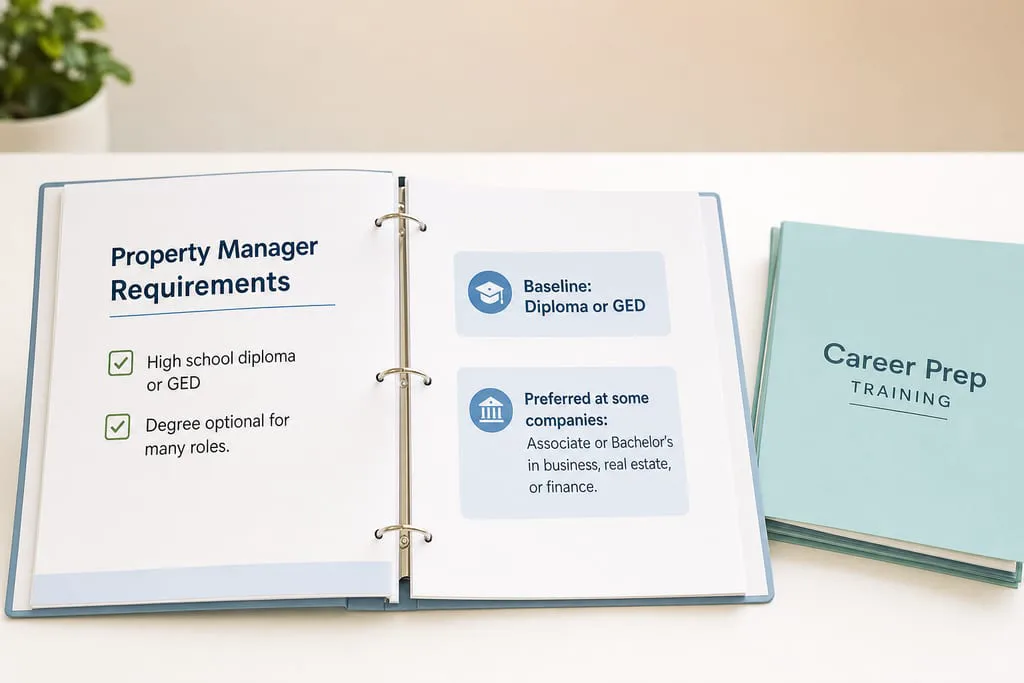
An associate or bachelor's degree in business, real estate, or finance can help you stand out, especially at larger management companies with formal training tracks. But a degree is a preference, not a requirement, for most property manager postings you will find.
Community college courses in real estate principles, accounting, or property law give you something a general degree often does not: practical knowledge you can use on day one, like reading a trailing twelve-month statement or understanding a lease addendum. Some employers specifically say they value that kind of targeted coursework over a broad degree.
- High school diploma or GED, required almost everywhere
- Associate or bachelor's degree in business or real estate, helpful but optional
- Single community college courses in accounting or real estate law, fast and practical
- Industry coursework tied to certifications, often weighed more than a general degree
Resources like the McKissock guide on getting started in property management break down which classes actually translate into job skills.
Get Hands-On Experience First
Most property managers do not start as property managers. They start as leasing consultants or assistant property managers, log time learning how a property actually runs, and move up once they have proven they can handle the job without supervision.
Maintenance techs have their own path upward: tech to maintenance supervisor, then supervisor to property manager, especially at companies that promote from the trades side instead of hiring managers from outside. Either route, the thing that gets you promoted is on-site experience with resident relations, rent collection, and unit turnovers, not a polished resume alone.
- Leasing consultant, the most common first job in the field
- Assistant property manager, closest seat to the role you want
- Maintenance technician, a trades-based path into the office side
- Resident relations or front-office admin, builds the people skills managers use daily
Plan on one to two years in a supporting role before you apply for property manager openings. Companies rarely hand the title to someone who has never collected rent, chased a late payment, or coordinated a move-out inspection.
Get Licensed and Certified
Whether you need a license depends entirely on your state's real estate commission, and that office is the final word, not a job posting or a blog. Some states require a real estate or property management license before you can legally manage rentals for someone else, and others have no such rule.
Licensing exams typically require a pre-license course followed by a passing test score, so budget a few weeks for the coursework before you sit for the exam. On top of licensing, certifications like CAM, CPM, or ARM add credibility on a resume and often lead to better offers, even in states with no license requirement at all.
- Check your state real estate commission's website first, before anything else
- Complete a pre-license course if your state requires one
- Pass the licensing exam with the state's minimum score
- Add CAM, CPM, or ARM certification to strengthen your resume
The requirement is set at the state level, so two managers doing the same job in different states can have completely different paperwork behind them.
Land Your First Property Manager Role
A resume built around numbers gets read faster than one built around duties. List your leasing percentages, occupancy rates, and any budget responsibility you carried as an assistant or leasing consultant, since those are the lines a hiring manager scans first.
Search property-specific job boards instead of general sites, since generic boards tend to recycle the same listings and bury smaller management companies that do not pay to boost visibility. Property Management Jobs lists direct postings from over 1,000 companies hiring now, updated hourly, which cuts down on the ghost postings and staffing-agency noise you run into elsewhere.
- Rewrite your resume around leasing numbers and occupancy rates
- Search property-specific boards before general job sites
- Apply to fewer, better-matched openings instead of mass-applying
- Sign up for a weekly job alert instead of checking manually every day
A weekly newsletter with new property manager openings saves you from refreshing search results every morning, and lets you focus your energy on applications that actually fit your experience.
Two Ways to Spend Your Job Search Time
Candidates who get offers in a few weeks usually prepare their numbers before they apply, not after an interview request. They can say "I managed 220 units with a $1.2M budget and 94% occupancy" instead of "I handled leasing and some admin work." Employers reading dozens of resumes flag the first type instantly, because it tells them exactly what you can handle on day one.
The candidates stuck applying for months usually mass-apply with AI auto-apply tools, firing off the same generic resume to fifty listings a week. That approach trades speed for accuracy, and hiring managers notice when a resume doesn't match the posting's specifics. Sending ten applications tailored to roles you actually qualify for beats sending fifty that ignore the unit count, budget size, or market the job is in.
Pay research is the other split. Candidates who check city-level pay ranges before an interview can negotiate from a number, while candidates who skip that step accept the first offer or lowball themselves. Compensation expectations now include specifics like leasing commissions, renewal bonuses, and on-call pay, so knowing your local range matters more than a generic national average.
| Approach | Time Cost | Best Fit |
|---|---|---|
| Mass-apply with AI tools | Low effort per application, high total hours wasted | Candidates with no track record yet, testing the market |
| Targeted applications with numbers | More prep time upfront, fewer applications sent | Candidates with at least a year of leasing, maintenance, or admin experience |
| Direct-posting boards | Slower to browse, fewer duplicate listings | Candidates targeting smaller management companies |
Smaller management companies often skip the big general job sites because posting and promoting there gets expensive, and they post directly on their own site or on property-specific boards instead. Candidates who only search Indeed or LinkedIn miss those openings entirely, even though smaller companies sometimes offer faster promotion tracks than large portfolios with rigid tiers.
Pick Your Target Role This Week
If you have leasing or admin experience, target assistant property manager openings. If you are a maintenance tech, target maintenance supervisor roles instead. If you have neither yet, start with leasing consultant, since that is the most common entry point into the field. Pick one of those three based on where you stand right now, then spend this week applying to that role only, through listings built for property management rather than a general job board. Property Management Jobs updates its listings hourly and lets you filter by that exact role, so you are not digging through admin postings that have nothing to do with the work. Sign up for the weekly newsletter so new openings land in your inbox instead of you checking back every day.
Common Property Manager Questions
Is it too late to switch careers into property management?
No, plenty of property managers come from retail, hospitality, or customer service rather than a leasing office. Those jobs teach you the same skills that matter here, handling complaints, juggling schedules, and staying calm under pressure. Start as a leasing consultant or assistant property manager to build the on-site track record employers want, regardless of your age or background.
Will I get stuck answering maintenance calls at all hours?
Some on-call work comes with the territory, especially for property managers and maintenance supervisors covering emergencies like a burst pipe at midnight. How often that happens depends on the property size and whether the company has a separate on-call maintenance line. Ask about on-call rotation and extra pay for it during the interview, since job listings on Property Management Jobs often spell out those details upfront.
Should I take a pay cut to move from leasing to an assistant property manager role?
Usually no, the move to assistant property manager should come with a raise, not a cut, since you're taking on more responsibility. If an offer comes in flat or lower than your current leasing pay, that's a sign the company isn't valuing the step up correctly. Compare the offer against local pay ranges before accepting, not just the title change.
What if my only experience is managing my own rental property?
Managing your own property counts as real experience, but employers will want to see it paired with professional skills like rent collection software, fair housing rules, and vendor coordination. List the specifics, like how many units you managed or what systems you used, rather than just saying you're a landlord. Pair that experience with a leasing consultant or assistant role to round out what a hiring manager is looking for.