
Maintenance Supervisor Job Description Duties and Qualifications
Maintenance supervisor job description covering duties, qualifications, pay, and what hiring teams actually look for. Read before you write or apply.

A maintenance supervisor job description centers on one thing: this person runs the maintenance team, not just a wrench. They coordinate repairs, manage unit turnarounds, and oversee vendor work across an entire property or portfolio, instead of handling one work order at a time. That's the line that separates the role from a maintenance technician. A technician fixes what's broken in front of them. A supervisor decides what gets fixed first, who fixes it, and whether a vendor needs to be called in.
The supervisor role sits in the middle, between hands-on repair work and the property management office. They still carry tools and walk units, but they also schedule staff, track turn times between move-outs and move-ins, and report status to the property manager. Getting the duties and qualifications right matters on both sides of a hire. A property management company that writes a vague posting ends up with a technician applying for a leadership job, or a supervisor candidate passing because the listing reads like an entry-level repair gig. A clear description, with real duties and real pay, saves both sides the mismatch.
Table of Contents
Where This Role Fits On A Property Team
A maintenance technician handles the work order in front of them: a leaky faucet, a broken AC unit, a clogged drain. The supervisor assigns that work, checks it when it's done, and steps in when a vendor is needed for something bigger like a roof leak or a boiler repair.
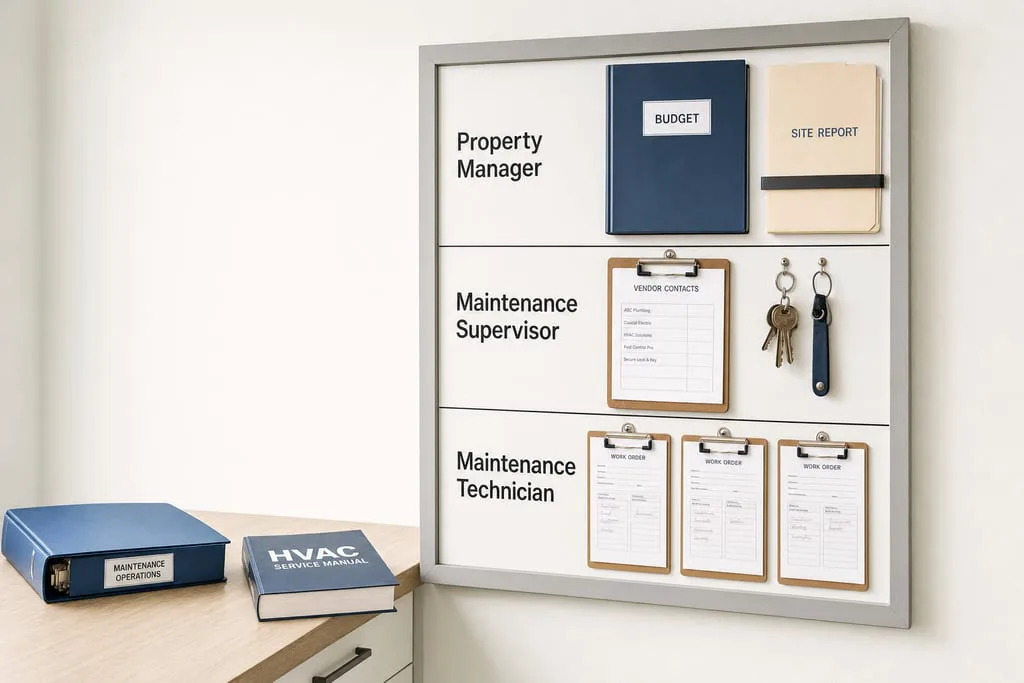
The property manager sits above both roles and owns the whole site, including leasing, resident issues, budgets, and reporting to ownership. The supervisor's job stays on the physical side of the property: units, common areas, equipment, and the crew that keeps them running.
Pay for these roles varies by portfolio size and region, but current postings give a rough range for each level.
| Role | Typical pay range | Scope |
|---|---|---|
| Maintenance Technician | $18 - $26/hr | One site, hands-on repairs |
| Maintenance Supervisor | $25 - $39/hr | One site or small portfolio, team and vendors |
| Property Manager | $55k - $70k/yr | Full site operations, leasing, financials |
A property with 150 units and a supervisor managing two techs looks different from a 600-unit portfolio with a supervisor running a crew of six plus outside vendors for HVAC and roofing. Unit count drives how much of the job is hands-on repair versus scheduling and vendor management, so a posting that lists the portfolio size tells a candidate more than one that just names the title.
Daily Duties You Will Actually Handle
A maintenance supervisor's day starts with the work order board, not a wrench. Before techs head out, the supervisor reviews what came in overnight, assigns jobs by priority and skill, and checks that yesterday's work actually got closed out correctly.
Unit turns eat a big chunk of the schedule, especially at properties with regular move-outs. The supervisor walks the vacant unit, builds the punch list, and sets a deadline so the unit is ready before the next lease start, since a late turn means lost rent the property manager will ask about.
Preventive maintenance is the part that keeps the job from being all fire drills. HVAC filter changes, plumbing checks, and electrical panel inspections get scheduled on a calendar instead of waiting for a resident complaint, and most properties expect this cycle to run monthly or quarterly depending on the system.
- Assign and track work orders across the whole crew
- Walk and approve vacant units before move-in day
- Run preventive maintenance on a fixed schedule
- Call and manage vendors for roofing, elevators, or major HVAC work
- Report turn status and repair backlogs to the property manager
Vendor coordination rounds out the week. When a job goes past what the crew can handle, like a boiler replacement or a roof leak, the supervisor gets quotes, schedules the vendor, and checks the work before signing off on payment.
Qualifications And Certifications Employers Want
Most employers want a candidate who worked as a maintenance technician first. Several years of hands-on repair experience is usually the baseline, since the supervisor has to know enough to check a tech's work and step in when a job gets complicated.
Certifications matter more at this level than at the technician level. EPA Section 608 certification is required for anyone handling refrigerant, which covers most HVAC work on a property, and a CPO certification is expected if the property has a pool.
Supervisory experience gets weighed too, even if it's informal. A tech who trained new hires or ran a small crew for a few months has an edge over one who never led anyone, since the job is as much about managing people as fixing equipment.
- Several years of technician-level repair experience
- EPA Section 608 certification for refrigerant handling
- CPO certification where the property has a pool
- Some prior lead or supervisory experience, formal or not
- Working knowledge of HVAC, plumbing, and electrical systems
A posting that skips these details usually means the employer hasn't thought through the role, which is worth noticing as a candidate.
Leadership And People Skills That Matter
The jump from technician to supervisor is mostly a people problem, not a tools problem. Scheduling a crew of two to six techs, balancing who's on a unit turn versus who's covering a work order, is a daily task that has nothing to do with fixing anything.
Training new hires falls on the supervisor too, covering safety rules and the property's specific standards for unit condition. A new tech who skips lockout-tagout on an electrical panel or leaves a unit half-finished reflects on the supervisor, not just the tech.
Budget conversations with the property manager are part of the job as well. The supervisor flags when a capital repair, like a roof or a parking lot, needs to move up the list instead of waiting for next year's budget cycle.
- Build and adjust the weekly tech schedule
- Train new hires on safety rules and unit standards
- Flag capital repair needs to the property manager
- Step in on resident complaints the tech couldn't resolve
Resident escalations land on the supervisor's desk once a tech can't close the issue, so staying calm with an upset resident matters as much as knowing how to fix what's broken.
On-Call Expectations And Emergency Response
On-call duty is one of the biggest differences between this job and a straight technician role. Most properties run a rotating on-call schedule among the maintenance team, with the supervisor covering extra shifts or stepping in when a call goes beyond what the on-call tech can handle, like a flood or a no-heat call in winter.
The supervisor also sets the response time standard the whole team follows. A common target is a response within 24 hours for routine work orders and much faster for emergencies, and the supervisor is the one who gets asked why a call went unanswered overnight.
Emergency repairs pull from a different part of the budget than scheduled maintenance, and the supervisor has to know which bucket a repair falls into before approving a vendor. On-call pay itself isn't standard across the industry, some employers offer a flat stipend, others pay hourly for after-hours calls, which is one detail worth checking on any job listing before applying.
- Rotating on-call shifts across the maintenance team
- Set response time standards for emergencies versus routine calls
- Track emergency repair costs separately from scheduled maintenance
- Confirm whether on-call pay is a stipend or hourly rate
Spotting A Posting Worth Your Time
A vague posting leaves out the details that actually tell you what the job is. If a listing skips unit count, crew size, and whether on-call rotates, treat that as a warning sign rather than an oversight. Those three facts determine whether you'd be running a six-person crew across 600 units or handling everything solo at a small site, and an employer who leaves them out hasn't thought through what they're hiring for.
A strong posting front-loads the numbers instead of burying them. Pay range, required certifications like EPA 608, and portfolio size should all appear near the top, not hidden in a paragraph about company culture.
| Posting signal | Weak listing | Strong listing |
|---|---|---|
| Pay | "Competitive salary" | "$25 - $39/hr" |
| Scope | No unit count listed | "150 units, crew of 2" or similar |
| On-call | Not mentioned | Stipend or hourly rate stated |
| Certifications | "Must be handy" | EPA 608 required, CPO if pool |
Extras like on-call pay, housing discounts, or tool allowances are another tell. An employer that spells those out has already worked through the cost of the role, which usually means they'll follow through on the rest of what the posting promises.
Before you apply anywhere, pull two or three postings for the same title side by side. The gaps become obvious fast: one lists pay and scope, another doesn't, and that comparison tells you more about the employer than anything in the job description itself.
Matching Your Background To The Next Opening You Apply For
Before you apply, line up your certifications and years of hands-on repair work against the duties in the posting, not just the title. If you don't have EPA 608 or any supervisory experience yet, a technician-to-supervisor move still works, but apply where the employer states that clearly instead of guessing from a vague listing. Check for pay, on-call terms, and unit count before you send anything, since those three facts tell you what the job actually is. Property Management Jobs filters listings down to maintenance-specific roles with that kind of detail attached, instead of mixing them in with generic admin postings. Apply to fewer openings that actually match your experience rather than every title that says "supervisor."
Maintenance Supervisor Career Questions
Do I need a college degree to become a maintenance supervisor?
No, a degree is not required for this job. Employers care far more about hands-on repair years, EPA 608 certification, and whether you've led a crew before. Trade school or an HVAC certificate program can help, but most supervisors move into the role after working as a technician, not after finishing a four-year degree.
How many units or properties does one supervisor typically manage?
That number depends on the property, since a supervisor at a small site might cover 150 units with two techs while a larger portfolio puts one supervisor over 600 units and a crew of six. Ask the hiring manager directly if a posting doesn't state unit count or crew size, since that question is fair to raise before you accept an offer.
Can a maintenance supervisor get fired for a vendor's mistake?
It's rare for a supervisor to be fired over a vendor's error alone, as long as they followed the normal process of getting quotes, checking references, and inspecting the finished work. What gets a supervisor in trouble is skipping that process, like approving payment before confirming the job was done right. Document the vendor selection and inspection steps so there's a record if something goes wrong later.
Is it normal to supervise technicians who have more years on the job than you?
Yes, this is common, especially when someone moves into the supervisor role from outside the current crew or gets promoted past longer-tenured coworkers. The job runs on scheduling, training standards, and vendor decisions, not seniority, so a newer supervisor with EPA 608 certification and strong organization skills can still run the team well. Property Management Jobs lists postings that spell out crew size and reporting structure, which helps you see what you'd be walking into before you apply.