Best Property Management Classes to Build Skills and Credentials
Compare the best property management classes for licensing, CAM certification, and job-ready skills, plus how to pick the right one.
By David Nix
Published

A good property management class costs anywhere from free to over $500, and the right one depends on whether you need a state license or just want to build skills for a resume. Search online and you will find dozens of courses with similar names, but only a handful actually match a specific goal like getting licensed in your state, learning Yardi or AppFolio, or picking up skills to move from leasing consultant to property manager. Pick the wrong one and you waste weeks and money on a certificate that does not move your application forward.
Licensing classes are different from skills-based certificate courses, and mixing them up is the most common mistake job hunters make. A licensing class is tied to your state's rules and is required before you can legally manage property or hold certain titles there. A certificate course, like those from NAA or IREM, teaches specific skills such as budgeting, fair housing law, or maintenance coordination, and looks good on a resume but does not replace a state license. Knowing which one you need before you pay for anything saves you from signing up for the wrong track.
Table of Contents
What Property Management Classes Actually Teep
Pre-licensing classes are set by your state and cover real estate law, trust accounting, and property manager duties required before you can legally hold a license there. Hours range widely by state, from a short online module to a multi-week course, and you take the state exam after finishing. These classes exist to meet a legal requirement, not to teach you how to do the job well.
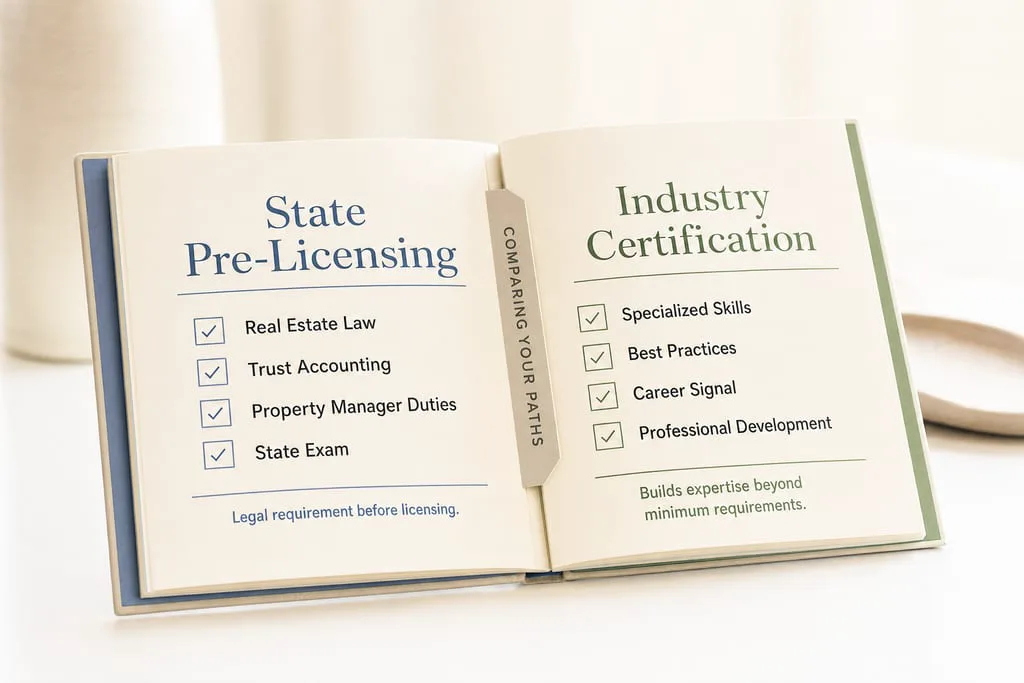
National certifications come from industry groups and signal a level of skill beyond what any state requires. The Certified Apartment Manager (CAM) and Certified Apartment Portfolio Supervisor (CAPS) designations from the National Apartment Association, along with the Certified Property Manager (CPM) from IREM, cover budgeting, leasing strategy, maintenance oversight, and staff supervision. These take weeks to months to finish and usually require some work experience first.
Short skills courses fill in specific gaps without the time or cost of a full certification. A one-day Fair Housing course, a maintenance basics workshop, or software training on Yardi or AppFolio can be done in a single sitting and still strengthen a resume.
- Pre-licensing: required by state, covers law and licensing basics, needed before you can hold certain titles
- CAM, CAPS, CPM: national certifications, cover management skills, built for career advancement
- Short skills courses: single topic like Fair Housing or software, no license or certification attached
A breakdown of training options is covered in more detail at Second Nature's guide to property management training, which lays out course formats side by side.
Classes That Lead to a State License
A state license is only required if you manage property for someone else, not if you run your own rentals. Texas requires a real estate license and 180 hours of pre-licensing education before you can sit for the exam. California requires 135 hours across three courses plus passing the salesperson exam before you can manage third-party property under a broker.
Courses run through state-approved providers like Champions School of Real Estate or Allied Schools, and most programs cost between $100 and $500 depending on the state and format. Self-paced online courses cost less than live classroom sessions, and some states let you count prior real estate education toward the hours.
- Confirm your state requires a license for the specific role you want, since some states only require it for managing property you do not own
- Check the exact hour requirement before enrolling, since it ranges from under 20 hours to over 180 depending on the state
- Pick a state-approved provider, since courses from unapproved schools will not qualify you for the exam
- Budget for the exam fee separately, since it is usually not included in the course price
Skip this path entirely if you plan to stay in leasing, maintenance, or on-site roles that do not require a license to hold the title.
Certifications That Boost Your Resume
National certifications are not legally required anywhere, but they tell an employer you have hit a certain skill level. CAM suits leasing consultants and assistant managers who want to move into a property manager title, since it covers budgeting, marketing, and resident relations in one program.
CAPS and CPM target people already running larger portfolios and usually ask for a few years of experience before you can enroll. Costs for these programs run from a few hundred dollars for CAM up to over $1,000 for CPM once you add exam fees and required coursework.
- CAM: best for leasing staff ready to step into management
- CAPS: best for managers overseeing multiple properties
- CPM: best for senior managers handling large portfolios or asset-level decisions
- Employer tuition reimbursement: ask your current employer before paying out of pocket
Weigh the cost against what it actually changes in your job search. If job postings in your target market keep listing CAM or CPM as preferred, the certification earns back its cost faster than waiting on experience alone to prove the same skills.
Short Courses for Specific Skills
A short course teaches one skill, not a full credential, and usually takes a single day or a few hours online. Fair Housing compliance courses are the most common one employers ask for, since leasing staff deal with fair housing rules on every showing and application.
Maintenance techs have their own short-course track, built around trade licenses instead of resume boosters. EPA 608 certification, required for anyone working with refrigerants in HVAC systems, is a federal requirement rather than optional training, and most techs complete it in one exam sitting after a short study period.
- Fair Housing certificate: half-day to one-day course, often free through local apartment associations
- EPA 608 certification: required by federal law for refrigerant handling, one exam, valid for life
- Software training: Yardi or AppFolio courses, usually a few hours, often free from the software vendor
- Basic bookkeeping for property managers: one to two day course covering trust accounting basics
These courses cost far less than CAM or CPM and finish in days instead of months, making them the fastest way to fill a specific gap a job posting calls out by name.
Matching a Class to Your Current Job Search
The right class depends on the role you are applying for right now, not the one you eventually want. Leasing consultants should prioritize Fair Housing certification first, then look at CAM prep courses once they are ready to apply for assistant manager roles.
Maintenance technicians should treat EPA 608 as non-negotiable before adding any other training, since many maintenance job postings list it as a hard requirement rather than a preference. Aspiring property managers need to check their state's licensing rules before spending money on CAM, CAPS, or CPM, since a national certification does not substitute for a required state license.
- Applying for leasing roles: start with Fair Housing, add CAM once ready for promotion
- Applying for maintenance roles: get EPA 608 first, add trade-specific certifications next
- Applying for manager roles in a licensing state: confirm license status before any national certification
- Applying for manager roles in a non-licensing state: CAM or CPM carries more weight on its own
Checking listings on a board built around property management and maintenance roles shows which credential actually shows up in job descriptions in your market, which beats guessing at what employers want.
Credential or Experience Which One Moves You Forward
A class only pays off when a legal requirement or a hard skill gap stands between you and the job. If you are chasing your first property manager title in a licensing state, or a job posting names EPA 608 or CAM by name, the class is not optional, it is the fastest route in. Outside those two cases, the math changes.
For assistant manager and leasing roles, hiring managers often weigh two years running a leasing office over a certificate earned last month. A resident relations problem you solved on the job demonstrates the same judgment CAM coursework is trying to teach, and it costs you nothing but time already spent. Stacking a second or third credential when you already have the experience rarely moves the needle on an application.
A targeted job search can outpace a training budget entirely. Spending a weekend applying to five roles that match your exact background often beats spending that same weekend studying for a certification exam you do not strictly need yet.
| Situation | Better move | Rough cost |
|---|---|---|
| No license, want a manager title | Take the state pre-licensing course | $100 to $500 |
| Two years leasing experience, no title change yet | Apply directly, skip CAM for now | $0 |
| Maintenance tech, no refrigerant cert | Get EPA 608 before applying | Under $100 |
| Already running a portfolio, job postings name CPM | Enroll in CPM | $1,000+ |
Pick the One Class That Fits Your Next Job
Write down the job title you want next, then let that single answer pick your class. A leasing consultant eyeing assistant manager needs Fair Housing, not CPM. A maintenance tech without EPA 608 needs that exam before anything else. A future property manager in a licensing state needs the state course before any national certification. One class, one goal, not three credentials sitting on a resume while the job search sits still. Once you finish, search for openings that name your new credential directly, since that is the fastest way to confirm it was worth the time and money. Property Management Jobs lists roles by title across the country, so you can see which postings actually call for what you just earned.
Property Management Class Questions
Will an online property management class actually get me hired without experience?
A class alone rarely gets you hired without any experience behind it. It can get your resume past a screen that lists a credential as required, like EPA 608 for maintenance or a state license for a manager title, but hiring managers still weigh real work handling leases, residents, or repairs over a certificate with no track record attached. Pair the class with an entry-level leasing or maintenance role to build the experience that actually closes the gap.
How long do I have to finish a certification like CAM once I start it?
The National Apartment Association sets the completion window for CAM, and it is commonly structured around finishing required coursework and the exam within a set period after your last class session, often under a year. Check the enrollment agreement for your specific cohort, since exact deadlines are set by NAA and your local apartment association chapter running the course, not by the employer who may be reimbursing you.
Can I expense a property management class through my current employer?
Many property management companies, especially larger ones like RPM Living, offer tuition reimbursement for CAM, CAPS, or CPM once you have put in some time on the job. Ask your supervisor or HR contact before you pay out of pocket, since some employers require pre-approval or a minimum tenure before they will cover the cost. Smaller employers may not have a formal program, so asking directly is faster than assuming one exists.
Do employers care which organization issued my certification?
Employers generally care more about what the certification covers than which group issued it, as long as it comes from a recognized name like NAA or IREM. CAM and CPM show up by name in job postings often enough that reading the actual listings on a board built around property management and maintenance roles tells you which credential employers in your market are asking for, rather than guessing which one carries more weight.