Top Property Management Interview Questions With Sample Answers
Top property management interview questions with sample answers for property managers, leasing agents, and maintenance techs. Prep smarter today.
By David Nix
Published
Most property management job interview questions fall into the same 10 to 12 categories, no matter if you are applying for a leasing consultant role or a maintenance supervisor job. Hiring managers ask about fair housing basics, how you handle a late rent conversation, and what you would do if a resident calls at midnight about a broken furnace. They repeat these questions because the job itself repeats these situations every week.
Generic tips about dressing well or arriving early will not help you answer a question about a resident screaming at you over a noise complaint. Hiring managers care far more about how you think through conflict and emergencies than whether you can recite the definition of a security deposit. A property manager who can describe one real eviction notice they handled, start to finish, will beat a candidate who gives a textbook answer every time. The questions and sample answers below show exactly what to say, in your own words, when the stakes are a resident's housing or a building's safety.
Table of Contents
- Why These Interviews Feel Different From Other Jobs
- Property Management Interview Questions On Difficult Residents
- Leasing and Sales Questions With Sample Answers
- Maintenance and Emergency Questions With Sample Answers
- Financials and Reporting Questions With Sample Answers
- Vague Answer Or Specific Answer, Which One Gets The Offer
Why These Interviews Feel Different From Other Jobs
A retail or office interview checks if you can follow a script and show up on time. A property management interview checks if you can make a fair, legal call in the moment, because the job hands you real authority over someone's housing or safety within the first week.
Interviewers weight their questions differently depending on the role you want. A leasing consultant gets more fair housing and sales scenarios, a maintenance tech gets more safety and troubleshooting questions, and a property manager gets more budget and staff-management questions.
| Role | Top question category | What they're really testing |
|---|---|---|
| Leasing Consultant | Fair housing scenarios | Whether you treat every prospect the same |
| Maintenance Technician | Emergency troubleshooting | Whether you can diagnose and act fast, alone |
| Maintenance Supervisor | Vendor and crew coordination | Whether you can run a turnaround on schedule |
| Property Manager | Budget and conflict calls | Whether you protect the owner's asset under pressure |
| Community Manager | Resident relations | Whether you can de-escalate without breaking policy |
Know which column applies to the job you're interviewing for before you walk in. It tells you which answers to rehearse and which ones you can skip.
Property Management Interview Questions On Difficult Residents
"Tell me about a time you dealt with an angry resident" usually points at a noise complaint, since almost every property manager has one on file. A solid answer: a resident called at 9pm about music overhead, you checked both units yourself, heard it, and issued a written warning under the lease, then followed up by email the next morning. That email matters, because a written record is what protects you if the complaint ever turns into an eviction case.
"How would you handle a resident who refuses to pay a late fee?" checks if you can hold a policy and still sound human. Explain that the fee is set in the lease, offer to check if the property's hardship policy applies, and if it does not, hold the line without getting cold about it.
"Describe a situation where you had to enforce a lease rule you personally disagreed with" tests whether you separate your own opinion from the job. A sample answer: you thought a no-grilling-on-balconies rule was strict, but you enforced it the same way for every resident, because inconsistent enforcement is what gets owners sued, as outlined in property manager interview breakdowns.
- Lower your voice instead of matching the resident's volume
- Write down the date, time, and exact words within the same day
- Apply the rule the same way regardless of who is asking
- Check written policy before offering any workaround
Leasing and Sales Questions With Sample Answers
"How do you turn a phone inquiry into a scheduled tour?" is answered by walking through a script, not a theory. Confirm move-in date and budget, mention one unit feature that matches what they asked about, then lock a tour time before hanging up instead of saying "call us back."
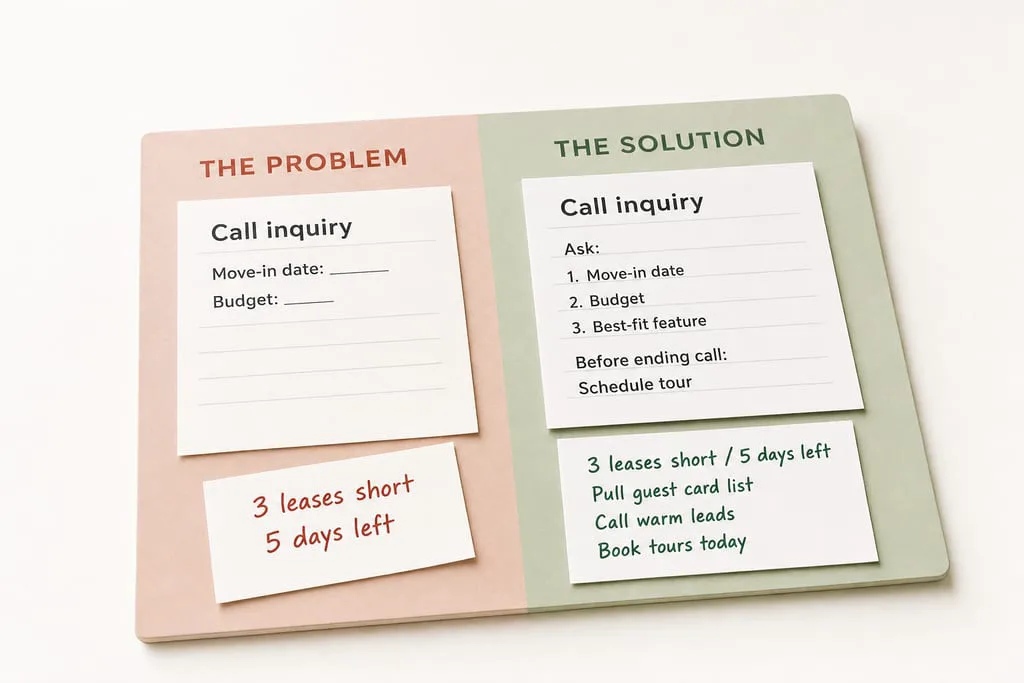
"What do you do if you're close to missing your leasing goal for the month?" wants a specific fix, not panic. A good answer names the number: if you're three leases short with five days left, you pull your guest card list, re-call every prospect who toured but didn't sign, and offer a move-in special if the property allows it.
"How would you handle a prospect who wants a unit you don't have available?" tests whether you lose the lease or save it. Offer the closest comparable unit, add them to a waitlist with a real date, and follow up the day a similar unit turns over.
- Confirm budget and move-in date on the first call
- Book the tour time before ending the call
- Call back every prospect who toured but hasn't signed
- Mention your current closing ratio if you track one, like 1 lease for every 4 tours
Maintenance and Emergency Questions With Sample Answers
"A resident calls at 2am with no heat in winter, what do you do?" has one right shape: triage first, vendor second. Ask if anyone is elderly, an infant, or medically fragile, check if it's a breaker or pilot light issue you can walk them through, and if not, call the on-call HVAC vendor and tell the resident when someone will arrive.
"How do you prioritize work orders when you have ten open at once?" is answered with a ranking, not a shrug. Safety issues like gas smells or exposed wiring go first, no heat or no water second, then everything else by the date it was submitted.
"Describe a time a repair didn't fix the problem the first time" wants honesty plus a next step. Say the part you replaced wasn't the actual failure, you told the resident directly instead of hiding it, and you had the right part on-site within a day. Safety issues always jump the line ahead of comfort complaints, no matter how long comfort complaints have been open.
- Gas leaks and exposed wiring first, always
- No heat or no water second
- Routine repairs ranked by submission date
- Tell the resident the timeline, don't leave them guessing
Financials and Reporting Questions With Sample Answers
"How do you explain a budget variance to ownership?" is answered with a cause, not an excuse. Say which line item went over, name the reason like an emergency roof repair, and show what you did to offset it elsewhere in the budget that same quarter.
"Walk me through how you'd handle a resident disputing a charge on their ledger" checks your process under pressure. Pull the ledger, show the resident the charge date and lease clause it ties to, and if you find your own error, correct it the same day instead of making them chase it.
"What financial reports do you review weekly and why?" rewards candidates who name real reports. Say you check the delinquency report every Monday to catch late payers early and the occupancy report to track which units are turning over, because naming the actual report names is what separates real experience from a guess.
- Delinquency report, reviewed weekly for late payers
- Occupancy report, reviewed weekly for turnover timing
- Make-ready report, reviewed to track vacant unit progress
- Variance report, reviewed monthly against the approved budget
Vague Answer Or Specific Answer, Which One Gets The Offer
Every sample answer above follows the same build: a specific situation, the action you took, and a result you can point to. A weak answer skips straight to a feeling, like "I stayed calm" or "I'd handle it professionally," and never names what actually happened. Hiring managers hear the vague version ten times a day, so it tells them nothing about how you work.
Strong answers also carry a hard detail, a number, a policy name, or a tool you used. "I prioritize by safety first" is a rule. "Gas smells and exposed wiring jump the queue ahead of a two-week-old work order" is proof you've actually run a queue. The same split shows up in leasing and financial answers, where naming the delinquency report or your tour-to-lease ratio does more work than saying you're "detail-oriented."
| Vague answer | Specific STAR-style answer |
|---|---|
| "I'd handle it professionally" | Names the resident issue, the step taken, the outcome |
| No numbers or policy mentioned | Cites a report, a lease clause, or a ratio |
| Sounds rehearsed and generic | Sounds like a real shift you worked |
| Hiring manager can't verify it happened | Hiring manager can picture it happening |
Use this pattern on any question not covered above, including ones about teamwork, turnover season, or a vendor dispute. Pick one real shift, name the action you took, and close with a number or outcome tied to it. If you can't name a number or a policy in your answer, you probably need a better example, not a better delivery.
Pick Five Questions And Say Your Answers Out Loud Tonight
Choose one question from each category above and rehearse it out loud, not in your head, with a real example ready: a specific noise complaint, a specific work order, a specific budget line. Say it twice. If you stumble on the number or the outcome, that's the part to fix before the interview, not during it. Then stop applying everywhere and apply to fewer roles that actually match what you just rehearsed, a leasing script helps you with a leasing consultant job, not a maintenance supervisor posting. Property Management Jobs lists openings by role, so you can match your prep to a job that actually asks these questions instead of guessing.
Leftover Interview Worries
What if I don't have a real example ready yet?
Pull from any job where you handled people, money, or a problem under a deadline, even outside property management. A retail shift where you calmed down an angry customer or fixed a register error works the same way a noise complaint does. Name the situation, what you did, and the outcome, then tell the interviewer directly that you're new to the industry but used to handling pressure.
Is it okay to ask the interviewer what software the property uses?
Yes, and asking shows you've worked a system before and want to know if you'll need training. Ask it near the end of the interview, after you've answered their questions, not as your first question. Naming a system you already know, like Yardi or AppFolio, also backs up any claim you made earlier about being detail-oriented.
How long should my spoken answer actually be?
Aim for 60 to 90 seconds per answer, enough time to state the situation, the action, and the result without wandering. Longer answers usually mean you're repeating yourself or adding details the interviewer didn't ask for. If you finish in under 20 seconds, you probably skipped the specific part and need to add the number or the outcome back in.
What if the interviewer asks something outside residents, leasing, maintenance, or financials?
Expect at least one question about teamwork, a scheduling conflict, or why you left your last job, since every hiring manager checks for basic reliability too. Answer it the same way as the role-specific questions, with a real shift, a decision you made, and what happened after. Property Management Jobs breaks out separate question categories by role on its site, so you can see which extra questions tend to come up for the specific job you're applying for.