Property Management Job Requirements and Qualifications
See the exact property management job requirements: education, experience, licensing by state, skills, and certifications employers want.
By David Nix
Published

Property management jobs requirements usually come down to four things: a high school diploma or college degree, some hands-on experience, a state license in certain cases, and the people skills to deal with tenants, owners, and vendors at the same time. What counts as "enough" depends entirely on which job you're after. A leasing consultant might get hired with zero experience and a friendly phone voice, while a property manager overseeing a 200-unit apartment community usually needs a license, a track record with budgets, and a few years managing staff.
Maintenance roles run on a different track altogether. A maintenance technician needs to know plumbing, electrical basics, HVAC, and general repair work, and some employers ask for EPA certification if the job involves refrigerants. A maintenance supervisor needs all of that plus the ability to run a team, schedule turnarounds, and manage vendor contracts. Licensing is the part that trips people the most, because it isn't federal. Some states require a real estate license to manage property at all, others only require it once you're handling leasing or collecting rent, and a handful of states have no license requirement whatsoever. The state you're applying in decides that, not the job title on the posting.
Table of Contents
What Employers Actually List in Job Postings
Every real posting on a job board sorts into four requirement buckets: education, experience, licensing, and skills. Employers test for these in the actual interview, not just on paper. An assistant property manager posting might ask for "some college preferred" while a senior property manager posting asks for a degree plus five years running a portfolio.
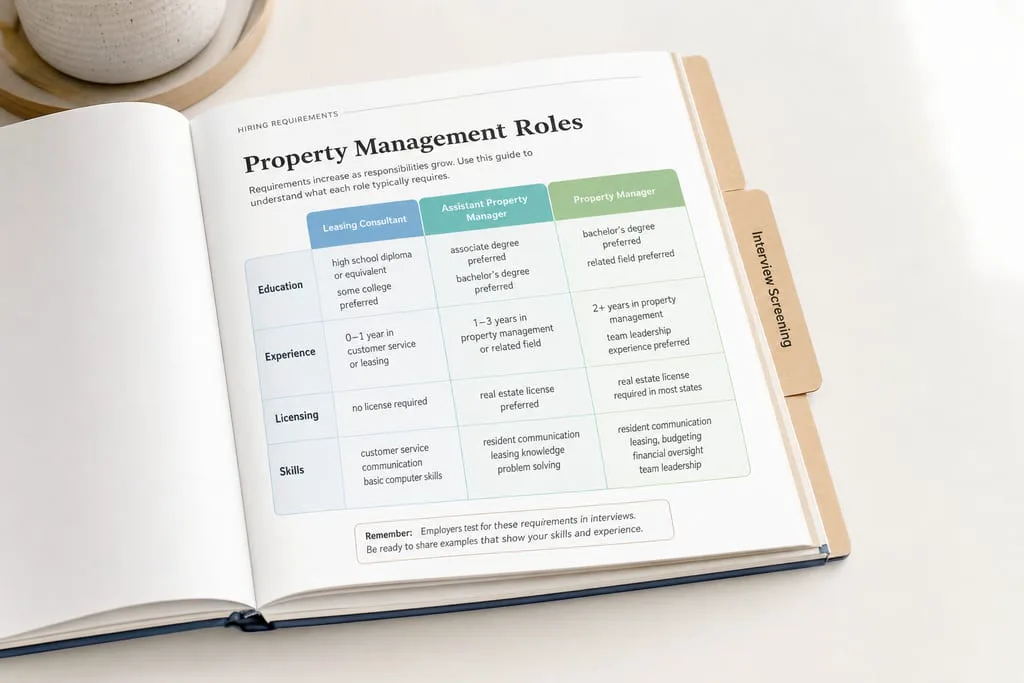
Requirements stack as the title moves up. A leasing consultant posting lists soft skills and maybe a year of customer service work. A maintenance supervisor posting lists certifications, years leading a crew, and experience managing vendor contracts on top of the hands-on repair skills a technician needs.
Pay and perks usually track with what the posting demands. A posting offering leasing commissions or renewal bonuses almost always pairs that with a leasing or sales quota requirement. On-site housing discounts show up mostly in property manager and maintenance supervisor postings where the employer wants someone living on property for on-call coverage.
| Role level | Typical requirement | Common compensation tie-in |
|---|---|---|
| Leasing Consultant | Customer service experience, no license | Leasing commissions per signed lease |
| Assistant Property Manager | Some college, 1-2 years on-site experience | Renewal bonuses, rent discount |
| Property Manager | Degree, license where required, budget experience | On-site housing, portfolio bonus |
| Maintenance Supervisor | EPA certification, crew leadership experience | On-call pay, vendor negotiation bonus |
For a broader look at how people move between these roles over a career, Rentec Direct's guide on getting into property management breaks down common entry points.
Step 1 Know What Each Role Actually Demands
Each title on a job board maps to a different set of daily tasks, and matching your background to the right one saves you from applying to jobs you're not ready for. A property manager runs the whole site: leasing goals, maintenance calls, vendor contracts, and the monthly budget all land on that desk. An assistant property manager handles the pieces underneath that, like resident requests, lease paperwork, and move-in coordination, while the property manager owns the financial side.
A leasing consultant has a narrower, sales-focused job: tour units, screen applicants, and get signatures on leases. Maintenance splits into two tracks that get confused a lot. A maintenance technician fixes what's broken that day, while a maintenance supervisor runs the crew and manages vendor work instead of doing every repair personally.
- Property Manager: budgets, staffing, leasing targets, owner reporting
- Assistant Property Manager: resident relations, lease admin, site support
- Leasing Consultant: tours, applicant screening, closing leases
- Maintenance Technician: plumbing, electrical, HVAC, unit turns
- Maintenance Supervisor: crew scheduling, vendor contracts, turnaround timelines
Pick the row that matches what you've actually done this year, not what you hope to do next year. Employers read resumes against this exact breakdown, and a mismatch is usually the first reason a resume gets passed over.
Building Your Experience and Education Floor
Most entry-level property management jobs ask for a high school diploma and some customer service background, nothing more exotic than that. A leasing consultant or front-desk role will take someone with retail or restaurant experience if they can talk to people and keep a schedule straight. The math changes once you aim at the property manager title.
Employers hiring property managers usually want 1 to 3 years in a leasing or assistant role first, because the job involves budget decisions and staff supervision that nobody picks up overnight. Maintenance works on its own scale entirely: a technician with real HVAC, electrical, or plumbing hours behind them often beats a candidate with a college degree and no trade background. Portfolio-level jobs, the ones managing multiple properties or a large multifamily asset, tend to ask for a business or real estate degree on top of the years in the field.
- High school diploma plus customer service experience for entry roles
- One to three years leasing or assistant experience before applying to property manager roles
- Trade hours in HVAC, electrical, or plumbing for maintenance positions
- Business or real estate degree for portfolio or multi-site roles
Build experience in that order and the resume reads as a logical climb instead of a jump.
Checking the Licensing Rules for Your State
Licensing for property management jobs requirements is set state by state, not by any single national rule. Some states require a real estate license before you can manage rental property on behalf of someone else, especially once you're collecting rent or negotiating leases for an owner. Other states carve out an exemption for on-site apartment managers working directly for the property owner, so the same job title needs a license in one state and nothing in another.
Community association management runs on its own separate track. Many states require a CAM license specifically for anyone managing an HOA or condo association, even if that same person already holds a real estate license. The detail that actually matters here is simple: your state's real estate board decides the requirement, not the job posting or the company hiring you.
- Confirm whether your state requires a license to manage rental property for others
- Check if on-site managers are exempt in your state
- Ask if the job involves an HOA or condo association, which may need a separate CAM license
- Call your state's real estate board directly before assuming either way
Associa's guide on becoming a property manager walks through how licensing ties into the broader path into the role.
Earning Certifications That Move You Up
Certifications aren't required to get hired, but they separate candidates when two people have similar experience on paper. The Certified Apartment Manager (CAM) credential is built for community and apartment management roles and signals you know leasing law, budgeting, and resident relations at a working level. The Certified Property Manager (CPM) designation sits higher up and targets people aiming at portfolio-level jobs down the road.
Maintenance has its own version of this: an EPA 608 certification is close to mandatory for any technician working on refrigerants, since handling them without it is a federal violation, not just a company policy. Fair housing training has become close to a universal expectation across the industry at this point, regardless of which role you're in.
- CAM for community and apartment management career paths
- CPM for portfolio-level career growth
- EPA 608 for maintenance techs working with refrigerants
- Fair housing training for any role that touches leasing or resident contact
Stack these in that order and each one maps directly to the next job title you're aiming for.
Deciding Between a Vague Posting and a Detailed One
A posting that just says "competitive pay" and "experience preferred" is asking you to guess. That guesswork costs you time: you apply, interview, and only find out in week two that the job wants on-call weekend coverage or a unit count you've never managed.
A posting that spells out the numbers lets you self-select in minutes. If a leasing consultant listing names the commission structure, you know the pay ceiling before you send a resume. If a property manager listing states the unit count and whether housing comes with the job, you know if your experience level actually fits.
Applying broadly to mismatched postings wastes effort on both sides. You spend hours chasing a job you'd turn down at the offer stage, and the employer spends time screening a resume that was never a fit. The faster path is narrower: fewer applications, better matches.
- Commission and bonus structure named, not implied
- Unit count stated, so you know the scope
- On-call expectations spelled out before you apply
- Rent discount or housing perk listed as a real number, not "negotiable"
Direct employers posting on Property Management Jobs are asked to include exactly these details upfront, which is why the listings read more like a job description and less like a guessing game.
Choosing the Role to Apply For Right Now
Look at what you've done this year, not what you want to do next year, and apply to that tier today. If you've got a year of leasing or front-desk work, apply to assistant property manager openings instead of waiting for a property manager title that wants budget experience you don't have yet. If you've never touched a lease, start with leasing consultant or technician postings and build the track record first. Before you send anything, call your state's real estate board and confirm whether the role needs a license, since that's a one-time check that settles the question for good. Then skip postings that hide pay and unit count, and apply only to ones that spell out commissions, bonuses, and on-call terms, which is the filter Property Management Jobs runs on every listing.
Property Management Job Questions
Can I apply for a property manager job if I only have leasing experience?
You can apply, but expect pushback unless you've also touched budgets or supervised staff. Most property manager postings want 1 to 3 years in a leasing or assistant role first, as covered already, but pure leasing with no site-level or financial duties usually points you toward an assistant property manager title instead. Apply there first and move up once you've managed people or a P&L.
Do maintenance technician jobs require me to own my own tools and truck?
Most employers supply a truck or company vehicle for on-site work and expect you to bring your own hand tools, not heavy equipment. Specialty tools like refrigerant gauges or diagnostic meters are usually provided by the employer, especially where EPA 608 certification is already required. A posting that expects you to supply a full truck and major equipment is the exception, not the rule, so confirm it before you accept an offer.
Will a criminal background check disqualify me from property management work?
It depends on the conviction, the state, and the employer, since there's no single rule across the industry. Roles that involve handling rent money, master keys, or vulnerable residents get screened harder than a maintenance or leasing role with less access. Some states also limit what employers can ask about older convictions, so a background check isn't automatically disqualifying just because something shows up.
What if the job posting doesn't list a salary or requirements clearly?
Ask the employer directly before you invest time in an interview, or look for a listing that already spells out the numbers. Property Management Jobs asks direct employers to post pay ranges, unit counts, and on-call terms upfront, so you can compare openings without guessing. A posting that stays vague after you ask is telling you something about how the job itself will run.