How to Become a Property Manager in Texas
How to become a property manager in Texas: when you need a TREC license, how to get one, and how to start without one.
By David Nix
Published

Short answer on how to become a property manager in Texas: it depends on what you manage, not on property management as a job title. Texas does not hand out one blanket license that covers every property manager in the state. If you plan to run single-family homes or a small multifamily property with no onsite office, the Texas Real Estate Commission requires you to hold a real estate license before you can touch rent or deposits. Run day-to-day operations at an apartment community with an onsite leasing office instead, and you are generally exempt, no matter how many units are on the property.
That split is the whole ballgame for anyone trying to figure out where to start. A leasing consultant or property manager working at a 300-unit apartment complex with a leasing office on site can take the job without ever sitting for a TREC exam. Someone hired to collect rent on a duplex, fourplex, or small 12-unit building with no onsite office needs a license first, and skipping that step carries real legal risk under Texas Occupations Code § 1101.758, including civil penalties up to three times the compensation received. Maintenance technicians fall outside licensing entirely as long as they stick to repairs and never handle rent or deposit money.
Table of Contents
Why Texas Splits Property Management Into Two Paths
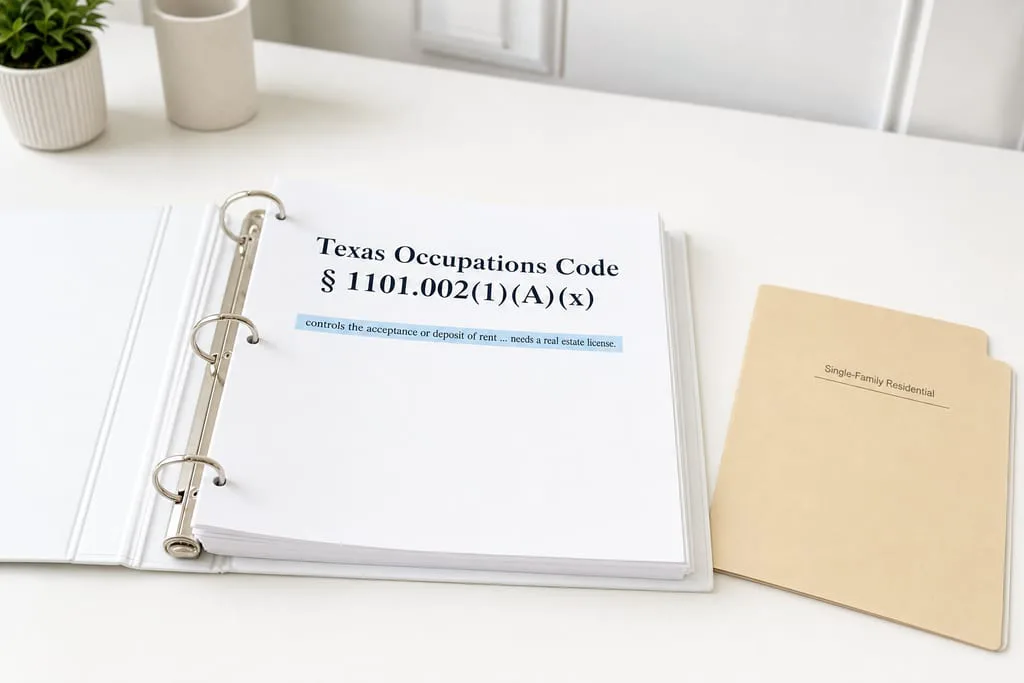
The license requirement comes from a single sentence in state law. Texas Occupations Code § 1101.002(1)(A)(x) says anyone who controls the acceptance or deposit of rent from a resident of a single-family residential unit, for compensation, needs a real estate license. That one clause decides the whole question, not the job title on your business card.
The exemption for apartment staff comes from where you sit, not how many doors you manage. An onsite leasing office at an apartment complex generally keeps the property manager and leasing staff exempt, whether the community has 40 units or 400. The office itself is what triggers the exemption, so a manager handling a small complex without one does not get the same pass.
That rule cuts both ways on smaller properties. A duplex, a fourplex, or even a 12-unit building with no onsite leasing office still falls under the licensing requirement if you handle rent or deposits there, regardless of how small the operation feels.
Owners get their own carve-out under a separate section. Section 1101.005 exempts an owner's direct employees who lease the owner's property, so someone on a landlord's own payroll, managing that landlord's buildings, does not need a license for that work.
- Single-family rent or deposit control, no onsite office: license required
- Apartment complex with onsite leasing office: generally exempt
- Duplex, fourplex, or small complex with no onsite office: license required
- Owner's direct employee leasing owner's property: exempt under Section 1101.005
Figure Out Which Path Applies To You
Match your target job to a property type before you spend a dollar on coursework. The dividing line is simple: who controls the rent, and is there an onsite office.
- Single-family homes or small multifamily buildings with no onsite office: license required
- Apartment complex with an onsite leasing office: exempt, even at 300 units
- Maintenance-only roles that never touch rent or deposits: no license needed
- Texas-licensed attorneys acting within their legal practice: exempt
A maintenance technician who fixes units and never handles a rent check stays outside TREC's rules no matter where they work. A Texas-licensed attorney handling a property transaction as part of their legal practice is exempt the same way, since the exemption follows the license they already hold. The property type decides your path, not your job title. Once you know which side you fall on, the next two sections split accordingly.
Complete TREC Education Requirements
Yes, you need specific hours, and a college degree can cover most of them. TREC requires 630 related-education hours to qualify for a sales agent license, and a bachelor's degree or higher satisfies that number regardless of your major.
- Confirm your related-education hours are covered by a degree, or plan coursework to reach 630 hours
- Enroll with a TREC-approved education provider, not just any school
- Budget for 90 SAE hours after licensing, including a required 30-hour Real Estate Brokerage course for first-time renewals
- Track toward 900 total hours if you eventually want a broker license
Full broker-level licensing currently sits at 900 total education hours, so sales agent licensing is the faster entry point most people manage single-family rentals with first. The 30-hour brokerage course isn't optional for a first renewal, it's part of the 90 SAE hours TREC requires. Every course has to come from a TREC-approved provider, so check that status before you pay for anything.
Apply, Test, and Manage Your License Through REALM
TREC moved license management to a new system, and you need an account there before you can do anything official. The REALM Portal launched December 15, 2025, and nearly 26,000 accounts were created right away.
- Create a REALM Portal account before applying for licensure
- Use REALM to renew your license once it's active
- File any complaints with TREC through the same portal
- Watch for broker qualification changes from SB 1968, effective January 1, 2026
A REALM account isn't a convenience, it's required for applying, renewing, or filing a complaint with TREC. Skipping the license altogether carries real cost: operating without one on single-family or small multifamily work risks criminal prosecution and civil penalties up to three times the compensation received under Section 1101.758. SB 1968's broker qualification changes took effect January 1, 2026, so anyone eyeing a broker license later should check REALM for the current rules before planning around old requirements.
Start Working The Exempt Apartment Path Instead
Skipping the license entirely means aiming at onsite apartment jobs, not single-family rentals. Onsite property managers, assistant managers, and leasing consultants at apartment communities typically don't need a TREC license at all.
- Apply for leasing consultant roles at onsite apartment communities as a common entry point
- Target assistant property manager jobs at the same onsite communities
- Look for maintenance technician or supervisor roles, which stay exempt as long as rent or deposits aren't part of the job
- Read job postings for the word "onsite," since employers usually state it clearly when the role qualifies for the exemption
A job posting that says onsite leasing office is telling you the licensing path up front, before you apply. Browsing by role on a property-specific board, the kind listing property manager, leasing consultant, and maintenance technician openings side by side, makes it easier to spot which postings fall on the exempt side. Starting as a leasing consultant at an onsite community stays the most common way into property management without sitting for a TREC exam first.
Picking Between Licensed And Exempt Right Now
The licensed path costs more time upfront but it's the only one that lets you manage single-family homes, small multifamily buildings, or a portfolio of scattered properties for a management company. If your goal is to run a book of rental houses for investors, or move into broker-level work managing properties across several owners, you need the TREC license. Skip it and you're locked out of that whole segment of the industry.
The exempt apartment path gets you earning sooner, but it caps you at onsite community roles. You can work as a leasing consultant, assistant manager, or property manager at an apartment complex with a leasing office, and climb that ladder for years without ever touching a TREC exam. What you can't do is take over single-family or small multifamily management without that license, no matter how much onsite experience you've built.
The REALM Portal and SB 1968 changes that took effect January 1, 2026 make the licensed route more paperwork heavy but also more traceable. Every step, from your first application to renewals to broker qualification, now runs through one account, so there's a clear record of where your license stands at any point.
| Path | Time to start working | Where you can work |
|---|---|---|
| Licensed (TREC) | Longer, 630+ education hours first | Single-family, small multifamily, portfolios |
| Exempt (onsite apartment) | Faster, apply directly | Apartment communities with onsite office |
| Exempt then licensed later | Fast start, license added mid-career | Both, once licensed |
A common move is starting exempt, building a track record as a leasing consultant or assistant manager, then pursuing the license once you know you want to manage single-family portfolios or move up to broker-level work. That order lets you earn while you study instead of paying 630 hours of tuition before your first paycheck in the field.
Decide What You're Managing Before You Decide Anything Else
Pick your property type first, since that choice decides everything else you do this month. If you want to manage single-family homes, duplexes, or a small complex with no onsite office, start your 630 related-education hours now through a TREC-approved provider, or confirm your bachelor's degree already covers that number. If you want to work apartment communities with an onsite leasing office, skip the coursework and apply directly to leasing consultant or assistant manager openings this week. Search a property-specific board like Property Management Jobs and read each listing for the word "onsite," since that single word tells you which path the employer built the job around before you ever submit an application.
Texas Property Manager Licensing Questions
Can I manage my own rental properties in Texas without a license?
Yes. The TREC license requirement applies to people managing property for compensation on someone else's behalf. If you own the home or building outright and handle your own rent and deposits, Occupations Code § 1101.002 does not reach you, since there is no third party paying you to control the money.
What if I work for a company that manages both apartment complexes and single-family homes?
Your license need depends on which properties you personally touch, not what the company manages overall. If your job has you collecting rent on the single-family side with no onsite office, you need a TREC license for that work, even if a coworker at the company's apartment complex stays exempt doing a similar-sounding job.
Do I need to redo my education hours if my real estate license is from another state?
That depends on what TREC decides when it reviews your out-of-state license and coursework. TREC evaluates transfers case by case through the REALM Portal, so the honest move is creating an account there and checking your specific hours against the 630 related-education requirement before assuming anything transfers.
What happens to my license status if I move between a licensed role and an exempt role?
Your license stays active in REALM even while you work an exempt apartment job that doesn't require it. Nothing forces you to let it lapse, so plenty of people hold a TREC license while working onsite at a leasing office, then switch back to single-family or portfolio work whenever that job comes along. A board like Property Management Jobs lets you browse both exempt and licensed-track openings side by side, so you can see which roles fit your current status before you apply.