How to Become a Property Manager in Florida
Learn how to become a property manager in Florida: license rules, CAM requirements, escrow law, and first-job steps explained simply.
By David Nix
Published

If you want to know how to become a property manager in Florida, the short answer is yes, you need a real estate license in almost every case. Florida law treats renting, leasing, or negotiating a lease on someone else's property for pay as broker activity, under Fla. Stat. § 475.01(1)(a). That license runs through the Florida Real Estate Commission, known as FREC, which sits inside the Department of Business and Professional Regulation, or DBPR. It is not a general business license you pick up at city hall, and it is not optional just because you call the job "assistant" or "leasing" instead of "manager."
There is one big fork in the road most people searching for this miss. If you plan to work for a salary on-site, leasing apartments as an employee of the community, you may be exempt from the real estate license requirement under Fla. Stat. § 475.011(4). But if your work tips over into managing a community association, like an HOA or condo board, with more than 10 units or a budget over $100,000, you need a separate Community Association Manager license under Chapter 468, not a real estate license at all. Two different paths, two different licensing boards, and picking the wrong one means starting over.
Table of Contents
Why Florida Regulates This Job So Closely
Florida treats leasing and managing someone else's property as broker work because money and tenant disputes are involved, and the state wants a licensed, accountable party on the hook. That's the logic behind Fla. Stat. § 475.01(1)(a): if you rent, lease, or negotiate a lease for another person's property and get paid for it, you're doing broker activity in the eyes of the law. The two exemptions carved out in Chapter 475 exist for specific, narrow situations, not as a general workaround.
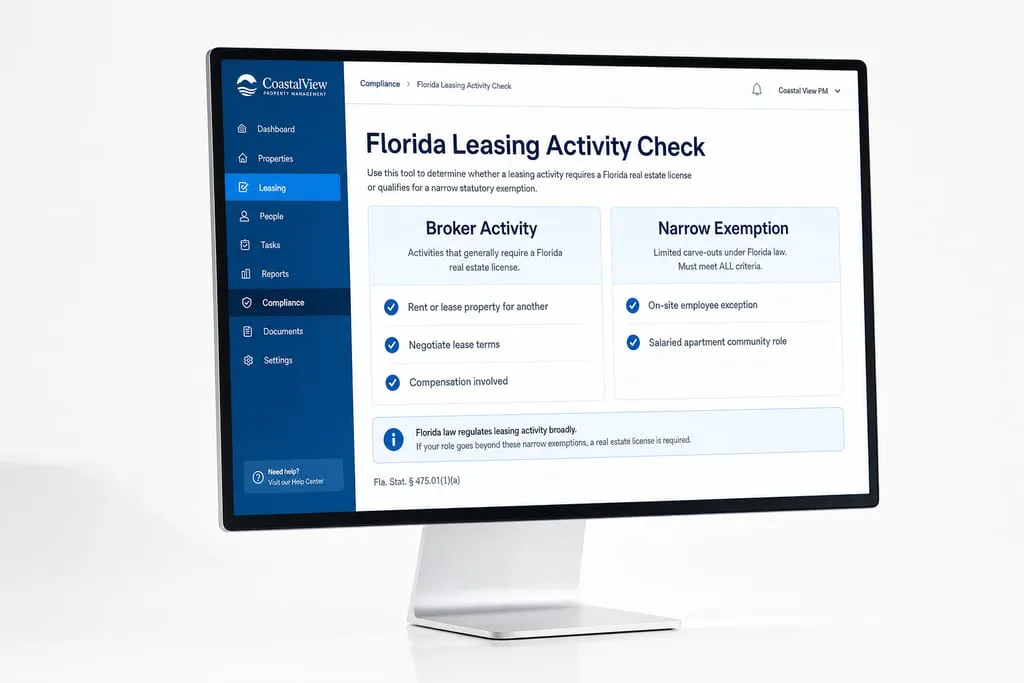
Salaried onsite apartment leasing staff skip the license under Fla. Stat. § 475.011(4), because they work directly for the community as employees rather than negotiating on behalf of an owner for a fee. Salaried condo or co-op managers get a similar break under Fla. Stat. § 475.011(5), but only when the units they rent out are leased for a year or less. Step outside those lines, and you're back to needing a license.
Community association work runs on a completely separate track. Managing an HOA or condo association with more than 10 units or an annual budget over $100,000 requires a Community Association Manager license under Chapter 468, issued through a different licensing process than a real estate license.
| License type | Governed by | Who needs it |
|---|---|---|
| Real estate license | Fla. Stat. § 475, FREC/DBPR | Anyone leasing or renting another's property for pay |
| No license required | Fla. Stat. § 475.011(4) and (5) | Salaried onsite leasing staff; salaried condo/co-op managers on leases of a year or less |
| CAM license | Fla. Chapter 468 | Managers of associations over 10 units or with a budget over $100,000 |
These aren't overlapping options you choose between. They're separate legal categories, and picking the wrong one on a job application can cost you the offer before you ever reach the interview.
Decide Which License Path Fits Your Work
Match your license path to the type of property before you sign up for any course. Rental or leasing work for third-party owners falls under the real estate broker license through FREC and DBPR, since you're negotiating a lease on someone else's property for pay.
HOA and condo work is different. If the association has more than 10 units or an annual budget over $100,000, you need a CAM license under Chapter 468 instead, not a real estate license.
Salaried onsite apartment leasing staff don't need a license at all, under Fla. Stat. § 475.011(4), because they work directly for the community rather than for an outside owner. And if you're the unlicensed friend who tipped someone into a lease, know the ceiling: an unlicensed person can collect no more than a $50 referral fee under Fla. Stat. § 475.011(13), and nothing beyond that.
- Leasing for an owner you don't work for directly: real estate license
- Managing an association over 10 units or $100,000 budget: CAM license
- Salaried onsite leasing employee: no license needed
- Referring a tenant without a license: $50 cap, nothing more
Complete Florida's Pre-Licensing Coursework
Most applicants start with FREC's approved 63-hour pre-licensing course, which you can finish online in as fast as 10 weeks. That course is the standard entry point for anyone without an out-of-state license already in hand.
There's a shortcut if you're licensed in one of nine states with a mutual recognition agreement with Florida: Alabama, Arkansas, Connecticut, Georgia, Kentucky, Mississippi, Nebraska, Rhode Island, and West Virginia. To qualify, you have to be a non-Florida resident, hold an active license earned through an original exam (not another reciprocity deal), be at least 18, and have a high school diploma or equivalent.
Even with mutual recognition, you still sit for a 40-question Florida law exam and need 75% to pass, scheduled through Pearson VUE.
- Confirm your home state is one of the nine recognized states
- Pull a certified license history from that state
- Submit your DBPR application at MyFloridaLicense.com with the fee
- Schedule and pass the 40-question Florida law exam at 75% or higher
Pass the Exam and Activate Your License
After the 63-hour course, full-path applicants sit for the complete Florida real estate exam, covering state law and practice. There's no way around it for anyone who isn't using the mutual recognition route.
One exception worth knowing: agents who've been licensed elsewhere for 2 of the past 5 years can waive the broker pre-licensing coursework. That doesn't waive the exam itself, just the coursework leading into it.
Once you pass, your license isn't live yet. A new sales associate license can't operate until it's affiliated with a licensed Florida broker, so line up that broker relationship before you count on working.
- Finish the 63-hour course or confirm your waiver eligibility
- Apply and schedule through MyFloridaLicense.com and Pearson VUE
- Pass the full Florida real estate exam
- Affiliate with a licensed Florida broker to activate the license
Handle Escrow and Compliance From Day One
Once you're licensed and collecting rent or deposits for owners, Florida's escrow rules apply immediately. Rents and deposits must go into an escrow account within 3 business days of receipt, per Fla. Stat. § 475.25(1)(k), held at a Florida bank, credit union, trust company, savings association, title company, or attorney.
Brokers can keep up to $5,000 of personal or brokerage funds in a property management escrow account, and monthly reconciliation statements are required under Fla. Admin. Code 61J2-14.010(2). Skipping either one isn't a paperwork slip, it's a licensing risk.
Mishandling escrow funds can mean fines up to $5,000, suspension up to 10 years, or revocation of your license under Fla. Stat. § 475.25(1)(d). Keep transaction and financial records for 5 years, since DBPR investigators can ask to see them during normal business hours.
- Deposit rents and deposits into escrow within 3 business days
- Keep personal funds in the account at or under $5,000
- Reconcile the escrow account every month
- Retain records for 5 years for DBPR review
Pick a Pace Based on Your Starting Point
Someone with no real estate background should expect the 63-hour course, exam prep, and broker affiliation to take a few months, depending on how fast they study. Online courses can be finished in as fast as 10 weeks, but most people need more like three to four months once you add exam scheduling and the wait for a broker to bring you on. If you're already licensed in Alabama, Arkansas, Connecticut, Georgia, Kentucky, Mississippi, Nebraska, Rhode Island, or West Virginia, you skip the 63-hour course entirely and move straight to the 40-question Florida law exam, cutting weeks off the timeline.
Licensing isn't a one-time event. Florida requires 14 hours of continuing education every two-year renewal, split into 3 hours of Core Law, 3 hours of Ethics and Business Practices, and 8 hours of specialty education. Budget for that every renewal cycle, not just at the start.
Once your license is active, the real hurdle isn't the state, it's finding a broker or employer willing to sponsor you. A sales associate license can't operate on its own, so job hunting and broker hunting happen at the same time for most new licensees. That's where it helps to search listings built specifically for property management and maintenance roles, rather than wading through generic admin postings or staffing-agency reposts while you're also trying to study for an exam.
| Path | Typical timeline | Who it fits |
|---|---|---|
| Full 63-hour course | 3-4 months to active license | No prior real estate license |
| Mutual recognition | Weeks, mainly exam scheduling | Active license in 1 of 9 partner states |
| CAM license track | Separate process under Chapter 468 | HOA or condo management over 10 units or $100k budget |
Each path still ends at the same place: a license that needs a broker before it can do anything. Property management work runs on broker and employer relationships as much as it runs on paperwork, so treat the job search as part of the licensing timeline, not something that starts after it.
Check Your State, Then Find Your Broker
Pick one move and make it this week. If you're licensed in Alabama, Arkansas, Connecticut, Georgia, Kentucky, Mississippi, Nebraska, Rhode Island, or West Virginia, pull your certified license history and start the mutual recognition application at MyFloridaLicense.com. If you're starting with no license at all, enroll in a FREC-approved 63-hour course today, since the online format can run as fast as 10 weeks. Either way, don't wait until your exam date to look for a broker. A new license can't work on its own, so line up a sponsoring broker while you're still studying, and once your license activates, you can move straight into applying for property manager and leasing roles instead of sitting on a license with nowhere to use it. Property Management Jobs lists openings built for that exact moment.
Florida Property Manager Licensing Questions
Can I manage my own rental property in Florida without a license?
Yes. Florida's broker licensing rule under Fla. Stat. § 475.01(1)(a) applies to managing someone else's property for pay. If you own the property yourself, you can lease and manage it without a real estate license. The license requirement only kicks in once you start handling rentals for other owners in exchange for compensation.
What happens if I manage properties in Florida without the right license?
You risk DBPR enforcement action, which can include cease-and-desist orders and fines against you or the business paying you. Operating as an unlicensed broker is a separate problem from the escrow penalties covered earlier, since it means you never should have been collecting rent or negotiating leases for an owner in the first place. Employers checking license status before hiring is standard, so this isn't a risk worth testing.
Does a CAM license let me also manage rental properties in Florida?
No. A Community Association Manager license under Chapter 468 only covers HOA and condo association work, not leasing or managing rental units for outside owners. If your job mixes both, like running a condo association and also leasing out individually owned units for landlords, you need both the CAM license and a real estate license. One does not substitute for the other.
Do I need to retake the pre-licensing course if I move to Florida from a non-mutual-recognition state?
Yes, unless you qualify for the separate coursework waiver. If your home state isn't one of the nine mutual recognition states, you take the full 63-hour pre-licensing course regardless of how long you've held a license elsewhere. The one exception is agents licensed in another state for 2 of the past 5 years, who can waive the coursework but still have to pass Florida's exam. Once you're searching for a broker to sponsor your new license, Property Management Jobs lists openings built specifically for property management and leasing roles, rather than general admin postings.
Explore jobs in property management jobs in United States Florida